

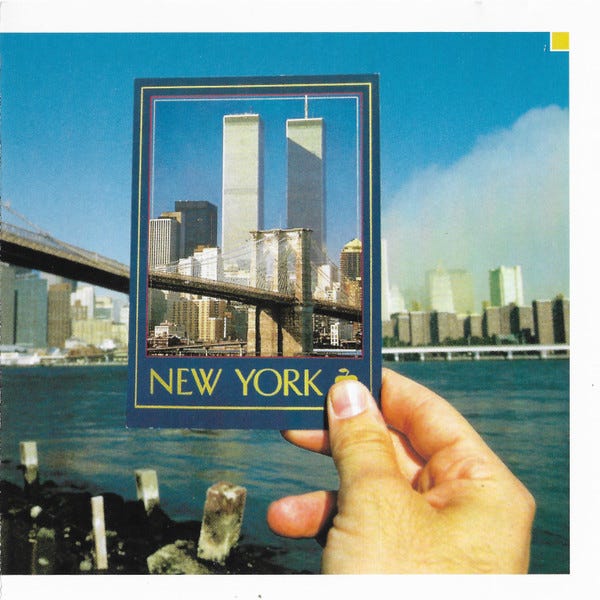
Village Voice’s CD compilation Wish You Were Here: Love Songs to New York
When we think about the cultural conversation surrounding the tragedy of the September 11th, 2001 attacks, particularly the musical aftermath, two threads generally come to mind. There was the patriotic musical response, mostly delivered via country hits (Alan Jackson’s roundly understood to be the dove to Toby Keith’s hawk), but also broad sentiments by Paul McCartney and Bruce Springsteen and others. And there was the infamous censorship spearheaded by Clear Channel’s blacklist, largely shunning hip-hop and angry rock music on radio playlists nationwide in favor of, well, Enya. Somehow the logical endpoint of both was the Dixie Chicks’ outspoken onstage criticism of George W. Bush and his piss-poor attempt to frame Iraq via military invasion with no evidence of WMDs, and their subsequent ex-communication from Nashville.
But mostly before those responses and their widespread ripples took place, Village Voice, the city’s premier bastion of arts and culture, put out a call asking for “love songs to New York” just weeks after the attacks. The music editorial staff sorted through hundreds of submitted tunes to find the 18 selections appropriated for Wish You Were Here: Love Songs to New York, an album ultimately released in March 2002 to benefit 9/11 first responders, and the only musical product ever released by “Village Voice Records.” Then-music editor Chuck Eddy was formally credited as producer alongside Jen Gapay and Doug Simmons, while several staffers and colleagues such as Douglas Wolk, Tricia Romano, and Robert Christgau were also involved in pulling it together. Christgau, who’s famously unafraid to take his own acquaintances and potential conflicts of interest to task in arts criticism, did end up lauding the compilation on his 2002 Dean’s List, praising it in an essay for its low sanctimony quotient, and it’s true, this album was far from “Courtesy of the Red, White, and Blue (The Angry American).”
The aforementioned examples of post-9/11 music, even Springsteen’s MSG-sized elegy for the fallen, did not have nearly as much Noo Yawk in them as Moe Tucker’s garage-rock “Fired Up” or the Mekons’ pounding “I ♥ an Apple” or ex-Slit Ari Up turning the Cookies’ girl-group classic into “Don’t Say Nothin’ Bad About NY.” Or Andrew W.K.’s silly-grandiose “I Love NYC” for that matter, or pianist Matthew Shipp’s “Amazing Grace” leading into DJ Lenny Dee’s gabber noisefeast “Extreme Terror” as a finale and an envoi. They certainly didn’t showcase the country’s multicultural epicenter the way Gogol Bordello or Peter Stampfel or Egyptian shaabi singer Hakim did. Minneapolis rapper Slug and Senegalese singer Baaba Maal and British-Punjabi critic’s darlings Cornershop all donated their own strong condolences, in the latter’s case literally “Returning From the Wreckage.” A nearly seven-minute Moby instrumental that played to Play’s strengths was loaned to open the entire thing, for commercial reasons and cleansing ones. Even if you hate this sort of thing (benefit albums, tribute albums, disparate artist comps), it’s hard to deny listening 25 years later that Wish You Were Here plays more like a city determined to thrive than any red, white, and blue bullshit.
RIOTRIOT spoke to Chuck Eddy via phone a quarter-century after putting the album together with his colleagues, to get a feel for what it was like navigating the tragedy and rallying artists to come together in response, before disgraceful warmongering and spying on our own citizens distorted what that means. The curious can buy the album used cheap on Discogs and read more about the hundreds of submissions that were not selected for inclusion in this contemporaneous piece by Douglas Wolk.
How did Wish You Were Here first get proposed?
[Laughs.] You know, I knew you were gonna ask that. I don’t remember. I mean, I don’t know whether the idea came from me, whether the idea came from the Voice promotions department; it could’ve come from [then-editor-in-chief] Doug Simmons. It’s 25 years from where the initial idea came from. But yeah, I was trying to remember that this morning, and I can’t.
Had you ever been involved in making an album before?
No. I mean, you know, compilation tapes for friends. I think it’s the only time my name is on Discogs. Basically I selected the songs with some help, whittled down the number and determined the song order. But I do remember there was a meeting we had — me and I don’t know who else; I’m sure Christgau was in there, I know Douglas Wolk was — where I played them different selections, especially ones that were kind of marginal. I initially wanted some tracks by lesser known or basically unknown artists. But that kinda didn’t end up flying. I guess there’s — what’s the name of the noise techno guy?
Lenny Dee?
Yeah. And honestly, I didn’t know who Andrew W.K. was.
I was going to ask how famous he was at the time. Christgau’s essay about the benefit comp was apparently published on the very same day as the American release for I Get Wet.
Douglas Wolk ended up going through all of them, and he did a lead review in the Voice, kind of an essay on them where he didn’t really name names. At any rate, I listened to all of them initially, and I remember hearing the Andrew W.K. thing; I just thought it was ridiculous, hilarious, but, like, unintentionally funny. And I’m like, ‘okay, this has gotta go out there.’ Then within a couple weeks, it turns out this is somebody that people are starting to talk about. I just hadn’t even come across his name before. I have a CD-R of tracks that I had considered by artists you can’t even find on YouTube or Spotify or whatever.
There was one I really loved called “Mary Lou” by an act called Spindly Jones. I guess that was a man’s name. And it was based on an obituary they read about somebody who actually worked in one of the towers. She was a fan of Michael Jackson. It talks about what her job was, what she worked on. And it’s kind of a power-pop song. I remember pushing for that. That was probably the most moving one I heard. There was one song called “Bin Laden” by a guy or a band named Hector. It was racist, I mean, he talked about “towelheads.” There was a power to it somehow? It’s been a while since I’ve even listened to these outtakes. There’s a Leaving Trains track that didn’t make it, a Les Savy Fav track that didn’t make it.
Oh, wow.
And there was a folk/Americana singer named Jan Bell, and hers was the only one that really took into account the potential for Islamophobia. She had submitted it within just a few days. I remember really being moved by that one. Everything stood out because she was the only person in any of the songs that was talking about one of the main things I was thinking about at the time, which, in retrospect, was obviously one of the big stories of 9/11. I also remember now, Montgomery Gentry submitted one. I wanted to get a Nashville country track on there. I think it was a song that was already on their first album, Tattoos and Scars. I played it in the meeting we had, and it was voted down or whatever. Actually, I’m not sure whether “voted down” would be the right verb. “Vetoed by Robert Christgau” might be more accurate. But again, it was 25 years ago, so the details are kind of fuzzy. I probably had 25 or 30 tracks that I narrowed it down from, according to the Wolk article, it looks like there were about 800 submissions.
Right. So the submission thing, I don’t actually know the origin. Did the Voice just put out a call for artists to write songs about New York, or the tragedy?
I think we ran a couple ads. I don’t know who else picked up the press release. I probably sent it out to publicists. I’m pretty sure that if you look at the music sections, probably starting late September, I’m guessing you’ll see an ad calling for submissions. Maybe we put up signs around the city or something. But there was definitely a call for submissions. And they came in on cassette and on CD-R almost entirely. The tracks that ended up on there probably came more through those channels. Baaba Maal and Hakim and Cornershop or the Mekons, whatever. Jon Langford, he knew Doug Simmons. Ari Up probably, too; in fact, I know we had a mutual acquaintance at the time. So some of it probably went out via word-of-mouth.
A good portion of the artists who made it on are name artists.
The vast, vast majority of submissions are people you’ve never heard of. Obviously, not all of the name artists made the cut; like I said, Montgomery Gentry is the one that I remember. And I think a fair number of those tracks may have been previously released in some form or another, like the Gogol Bordello track. Wolk mentions a track that is, like, copyright 1976.
How did you select artists to reach out to? Like, Cornershop doesn’t strike me as a band with obvious connections to the city and they hadn’t made an album in five years.
It was probably through a publicist. I’m guessing very few of the tracks on there were recorded specifically for the project. I’m guessing something like Baaba Maal, Bob [Christgau] may have put in a call. I may have called Eugene Hütz. He had a regular DJ gig I went to, an all-night Saturday thing where he would play Captain Beefheart and Manu Chao and dance on tables; it was pretty wild. I remember getting beers with him a couple of times. Whether I called the publicist and asked him for a track, I don’t know. Looking down the list, I’m pretty sure we didn’t ask Sheila Chandra, which was a track that I know Christgau did not like. [Laughs.] I remember he thought it was cheesy. I liked the idea of getting a couple Middle Eastern artists on there; that was definitely intentional. But I know no one reached out to Sheila Chandra, I know that. Peter Stampfel was friends with Bob, so I’m guessing there’s a good chance he contacted Peter. Jon Langford, I think, was pretty close friends with Doug Simmons, so there may have been a connection there. The two jazz artists, I think they just submitted them. The Lenny Dee thing, I’m pretty sure he or his people submitted it. Some we reached out to, some came over the transom. Submitted on spec, in Village Voice terms. [Laughs.]
Listening to Moe Tucker’s remake of her own song “Fired Up,” with 9/11-themed lyrics now is really jarring in the context of her descent into jingoism. Do you remember how that one came about?
Not offhand. My guess is she submitted it. I don’t think anybody reached out to her specifically. Loudon Wainwright, Bob may have had a connection with him. I haven’t played the album in years, so I can’t remember what the Atmosphere song had to do with 9/11. I don’t even have a copy. I got rid of my CD collection last year and that went with it.
Christgau actually commented at the time that he loved Atmosphere but didn’t understand how that track fit the theme.
Maybe we just liked Atmosphere and liked having him on there. I don’t know the translation of the Baaba Maal or…was the Gogol Bordello song partly in English? I’m guessing the Cornershop one was already recorded, and they thought that it fit.
That one’s an eerie fit. The title and such.
And the Andrew W.K. one, is that on his first album?
I was trying to figure out if it’s some kind of early alternate version, but it sounds just like the album one.
He had been recording with Wolf Eyes. I just remember hearing that and thinking, ‘this is so incredibly stupid. It has to go on there.’ And, again, I had no idea who he was. I just thought it was really good. Uri Caine and Matthew Shipp, I’m guessing those probably were already recorded. I mean, is the Uri Caine one instrumental? For all I know, he could’ve changed the name.
The Ari Up track is the one I really remembered, do you recall which of the final inclusions moved you the most?
“We’re Still Here,” the Stampfel one. I don’t know why that was under the name the Du-Tels. Maybe that was a contractual thing. Is Peter Stampfel even under contract? [ed. note: The Du-Tels were Peter Stampfel and Gary Lucas.] I know I decided to put that Lenny Dee thing at the end. I liked the idea of having something really violent.
After “Amazing Grace.”
Yeah. [Laughs.] And that it was called “Extreme Terror.” It’s almost unlistenable, if I remember right. I had reviewed an album for SPIN that had him and some other…whatever they called that noisy techno. It wasn’t digital hardcore. Maybe it was digital hardcore-adjacent.
Gogol Bordello was another contribution that felt ahead of its time to me, though I just Googled and found a New York magazine Nightlife stub where Eugene was apparently modeling for Marc Jacobs in 2000.
Christgau might not remember this, but I introduced him to Gogol Bordello. They were probably my favorite local band at that point.
Do you have any idea how many copies of the album were made?
Not off the top of my head. And I don’t remember how many sold either. It was probably not more than a couple thousand. I don’t think we made that much money; it was supposed to be a benefit for first responders, so it’s not like I was following the money trail after.
Was it sold in New York record stores, or you had to order it through the Village Voice?
I think we probably got it into stores. Wow, distribution. That’s a good question. But people were still selling stuff in stores, there was still a brick and mortar element. Whether it got into stores outside of New York, I don’t know. But I’m sure we got into some in New York.
Anything else you remember about that period?
I just remember bringing home this huge crate of submissions and staying up all night a few nights listening to these. Probably a lot of them I didn’t even get through the songs. The CD-R ones were probably more logistically easy to deal with than the cassettes. But I did go through all of them and divided them into piles: definite, indefinite, and then a gigantic pile of no way.
How long were you going through submissions? Like, a few weeks?
We probably gave it till the end of October. I remember Douglas Wolk really liking the submission by, well, she wasn’t my wife yet but my girlfriend and her band, The Color Guard. It was called “En Why.” He doesn’t mention any artists in the piece. They were a Raincoats kind of band. I’m too close to it to judge how good even the selections are.
But if you’re whittling down from 800 submissions, at one point, you weren’t too close.
I kinda resented it all had to be name artists. I mean, I know you’ll sell more copies, and we were trying to make money for charity. But I still think that there’s something to be said, you know what I mean? I would have liked to have included a couple.
If it was released now, it would probably be a pay-what-you-want zip file of, like, 200 songs on Bandcamp.
Yeah. That makes sense, too. And I also resented not having a Nashville country song on there. I wrote an essay about country’s reaction, and I kind of make the case in there that I think that country probably, rightly or wrongly — in a lot of cases wrongly — dealt with the historical event more than any other genre did. The Alan Jackson song, the Toby Keith song, the Darryl Worley song, whatever you think of them. I felt like that genre should have been a part of this. But people were not really, including Bob, were not open to Nashville country at that point, which is their own prejudice. I don’t remember putting up a huge fight or whatever. I just think it was a wrong decision; you know, maybe it should have been 21 songs instead of 18.
I’m sure at the time that feeling was probably colored by the nature of the country songs that were happening, like the Toby Keith song.
They weren’t even out yet.
Really?
I don’t think so. You’d have to look to see. [He’s right; the Alan Jackson song came out in late November, the Toby Keith song came in late May 2002, the Darryl Worley song was, gosh, March 2003 -ed.] And I think Bob actually ended up liking the Alan Jackson song. But it wasn’t like they were instantaneous. I think it was the genre. It was an assumption about…you know, I mean, maybe if there had been a Dixie Chicks submission. I’m not trying to get cranky about it. I just remember it kinda getting on my nerves then.
It’s definitely notable to document how you were feeling at the time and under the duress of the event itself, having to suddenly do this thing that you’d never done — curating an album.
Well, it was fun. I remember it being fun, but I remember it being a lot of work, and I don’t think they paid me extra. [Laughs.]
This interview has been edited for concision and clarity.